
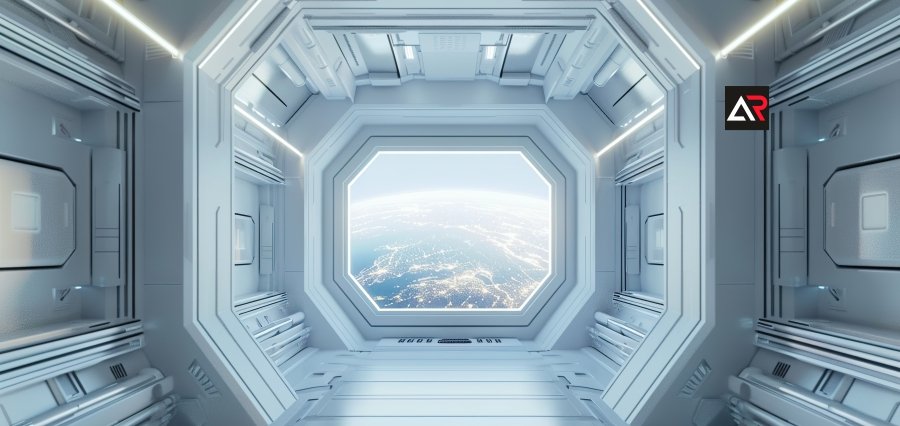
Building Cosmic Futures
For centuries, humanity has looked up at the night sky with wonder, dreaming about what lies beyond our planet. Today, that dream is slowly becoming reality. We are entering an era where space is no longer just a place to explore; it’s becoming a place to build, create, and live. The next generation of technology will not only be inspired by space but also built in space. This shift could redefine how we think about innovation, industry, and even life itself.
The Limits of Earth
Our home is the Earth, but it has its boundaries. The creation of new technology on our planet is frequently associated with the issue of gravity, pollution, and limited resources. These issues are more severe as we proceed. Indicatively, some of the materials required in advanced electronics and batteries are hard to find or mine. The factories generate waste, which is harmful to the environment, and the planet is already straining due to excessive production.
Most of these issues disappear in space or are at least simplified. It has no gravity to obstruct manufacturing processes. There is unlimited sun that can power. And raw material is almost infinite, and it is floating in asteroids and other heavenly bodies. We have an opportunity to take some of our production to space and release some pressure on the Earth as well as open new opportunities.
Why Build Space?
Microgravity is one of the largest opportunities of space manufacturing. Materials do not act in space. As an example, researchers have discovered that microgravity fiber optic cables produced are much more effective as compared to those produced on the ground. It would result in quicker internet and communication. On the same note, it is possible to manufacture more accurately in space some alloys, crystals, and medicines resulting in higher quality and performance.
Another reason is energy. Solar power is far more efficient in space as there are no clouds or night. Solar panels placed in space would have the potential of collecting energy all the time and transmitting it to the earth. This technology is already at testing, and in the future it may be able to supply millions of people with clean energy without destroying the planet.
Next, there is the prospect of asteroid mining. The asteroids are also home to many precious metals such as platinum, gold, and nickel, among others, which are finding their way to scarce resources back on Earth. The future businesses might instead extract these space rocks to provide valuable materials instead of digging deep into our planet to aid the space and earth industries.
The Role of Space Stations and Lunar Bases
Infrastructure is needed to accomplish all of this. The International Space Station has been a major initial move, yet it has not been the end. We are expected to itness the more advanced space stations in the next several decades that will be constructed with the purpose of researching and producing. Orbital factories and habitats are already being planned by the private companies, SpaceX, Blue Origin, and Axiom Space.
The Moon might have a major role as well. It has low gravity thus it is easier to launch goods there than on the earth. Lunar base may be a construction and refueling base of missions further into the solar system. There is a high possibility that the initial space-built satellites, solar panels or even spacecraft may be assembled on or around the moon.
A New Economy Beyond Earth
With the continued transfer of industries into orbit, there will be a new form of economy in existence, the type that occurs between planets. The work in engineering, construction, communication, and logistics will be taken to space. When mechanics are working on satellites, scientists are cultivating medicine in microgravity laboratories, and robots are building solar farms in the atmosphere of the Earth, then imagine that.
This growth will not only transform technology, it will transform us as well. Humanity will cease to be a species on one planet. We might be able to stretch a long way beyond our blue planet in our future inventions, cities, and communities.
The Road Ahead
There are still many challenges ahead, from high costs to safety concerns. But every major leap in history has started with bold dreams. Just as the industrial revolution reshaped life on Earth, the coming “space revolution” could shape our cosmic future.
Building technology in space isn’t science fiction anymore; it’s science in progress. The next generation of innovation will rise not from the ground beneath our feet, but from the stars above our heads.