
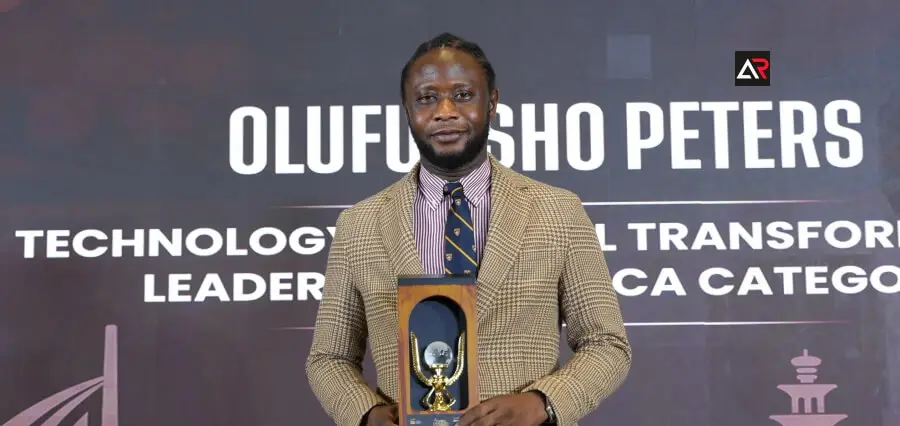
Long before boardrooms and global partnerships entered the picture, Olufunsho Peters was originally a young technologist who found his inspiration through emerging technology possibilities. The time he dedicated to teaching himself computer operations developed into a mission that aimed to change technology applications in African countries. Starting with basic funding and no external financial support, he established Infinion Technologies through his personal dedication to building the company from its initial stage.
He is currently serving as CEO at Infinion Technologies, which operates throughout 99 countries, specializing in cloud computing, artificial intelligence, and cybersecurity services. His entrepreneurial journey demonstrates his business skills but also shows his ability to lead change through his understanding of African business opportunities and his ability to create the future. He has used every difficulty created by COVID-19 to develop new business opportunities through enterprise artificial intelligence implementation. The central tenet of his leadership beliefs states that technology should create advantages that empower individuals while reinforcing organizational systems and providing widespread access to advantages.
From Self-Taught Coder to Tech Transformist
Olufunsho traces the roots of his entrepreneurial identity to the earliest chapters of his professional life. “My career started out with me sitting with computers,” he recalls, describing a period of intense self-directed learning that would shape the leader he was becoming. Long before he thought in terms of boardrooms and enterprise strategy, he was simply a young man fascinated by what machines could do and, more importantly, what they could help people do.
As time passed, the vision expanded. He began to imagine not just working with technology but building an organization around that talent, a large corporation that could harness the power of digital tools to create measurable value across Africa. He recognized, even then, that the continent held enormous, unrealized potential, not because of a lack of ambition among its people, but because of structural gaps: inadequate infrastructure, limited access to enterprise-grade technology, and a dearth of organizations willing to solve for the African context rather than simply import solutions designed elsewhere.
That diagnosis shaped INFINION’s strategic identity from the very beginning. Rather than building a generalist technology company, Olufunsho zeroed in on three disciplines: cloud, artificial intelligence, and security, and deliberately combined them into what he describes as a “multidisciplinary delivery approach.” The logic was precise: Africa’s technology challenges were not one-dimensional, and any solution that addressed only one layer of the problem would inevitably fall short.
COVID as Catalyst: Reimagining the Business
If Olufunsho ‘s early career laid the philosophical groundwork for INFINION , the COVID-19 pandemic provided the crucible. While the global health crisis devastated countless businesses, he saw something different: a rare opening. “We remodeled our operations to see where value lies,” he explains, noting that the pandemic forced every business leader to confront infrastructure dependencies they had previously taken for granted.
For Africa, the shift to remote work exposed long-standing infrastructure deficits in sharp relief. Organizations that depended on physical hardware found themselves paralyzed by procurement timelines that stretched months. The traditional process of sizing a solution, ordering equipment, waiting for delivery, and finally implementing it could consume nine to twelve months, a lifetime in a crisis environment. INFINION moved decisively. The company doubled down on cloud-first delivery, demonstrating to clients that a solution that might take nearly a year through conventional hardware procurement could go live in three to four weeks using cloud infrastructure.
This wasn’t merely a pivot in sales strategy. It represented a fundamental reimagining of how INFINION approached the African market, acknowledging that the very infrastructure challenges the continent faced were, paradoxically, the company’s greatest commercial opportunity. While others saw a broken road, Olufunsho saw a reason to build a faster vehicle.
The Digital Wallet Story: Innovation in the Trenches
Abstract claims about innovation rarely tell the full story. The real measure of a technological company lies in the specifics of the messy, complicated, real-world problems it solves for actual clients. Olufunsho offers a telling example: a project INFINION undertook for one of Africa’s largest banks.
The bank wanted to implement a digital wallet solution. One that is straightforward enough to be ambitious on paper, except that the solution vendor’s requirements mandated the purchase of a large volume of servers. The bank lacked that infrastructure, which meant launching into a procurement process that would involve buying hardware, arranging shipment, and waiting, a process that, by his estimate, would have taken more than nine months for the hardware alone.
INFINION’s team proposed an alternative. Rather than defaulting to a traditional on-premises build-out, they designed a cloud hybrid solution that leveraged the bank’s existing infrastructure while integrating the cloud capabilities INFINION brought to the table. The result: the solution went live in two months. The team then layered security protocols on top of the cloud foundation and added AI capabilities that would have been impossible to deploy without first solving the infrastructure problem.
“We find unique ways of solving these infrastructure issues,” he says, framing the anecdote not as an exceptional achievement but as a standard expression of INFINION’s operating philosophy. The story encapsulates a wider truth about the company: its competitive advantage lies not just in technical capability, but in its willingness to rethink the assumptions that other vendors bring to the table.
AI’s Promise for Africa: Population as Strategic Advantage
Few topics generate as much anxiety in the global business community as artificial intelligence and few leaders navigate that anxiety as confidently as Olufunsho . He pushes back against the prevailing narrative that AI threatens to replace workers, offering instead a more nuanced and, ultimately, more optimistic view.
“AI is not here to replace people. What I see is that more people who learn to use AI will cause a massive transformation,” he asserts. To illustrate, he points to the operational realities of Africa’s port sector. Imagine, he suggests, 30 port operations spread across different African countries, each staffed by customs agents manually processing goods. AI can help those agents automate the classification of goods and perform faster, more accurate valuations for customs duty calculations, not by replacing the human beings who staff those ports, but by dramatically expanding what each one can accomplish.
This is where Olufunsho identifies a counterintuitive strategic advantage for Africa. The continent’s large and growing population, often cited as a development challenge, becomes in his framework a force multiplier for AI impact. “The larger the scale, the more people, the easier it is to create impact with AI. Africa has a strategic advantage based on the population that it holds,” he explains. If those populations master the use of AI tools, the resulting transformation could be groundbreaking, accelerating productivity gains that took other regions decades to achieve.
Microsoft Copilot Ready: Earning the Right Credentials
In the competitive world of enterprise technology, credentials matter. They signal to clients that a partner has not just purchased a certificate but has genuinely built the internal expertise that certification represents. By that measure, INFINION ‘s track record with Microsoft stands out. In five years, the company has earned five out of six Microsoft Solution Partner badges and holds 12 to 13 Microsoft specializations in its region, a roster that places it among the more decorated Microsoft partners on the continent.
The most recent addition to that collection is the Microsoft Copilot Ready Tier Partner Status, an acknowledgment of INFINION ‘s capability to lead client conversations around AI adoption using a consulting-led approach. Olufunsho frames this achievement not as a trophy but as a demonstration of the company’s commitment to helping clients navigate the AI journey securely and intelligently.
“This copilot-ready status is just one more way of demonstrating our deep expertise in leading customer conversations, helping them navigate the AI journey securely and create the end state of being transformed digitally by using AI,” he says. The phrasing is telling about his positions INFINION not as a product vendor pushing software licenses, but as a trusted advisor guiding clients through one of the most consequential technology transitions of the current era.
Innovation as a Daily Practice
Ask Olufunsho to define innovation at INFINION , and he resists the temptation to reach for the glossy language that fills most corporate brochures. Innovation, he says, looks like “a daily routine,” a cultural orientation that permeates the company rather than a department or a quarterly initiative.
The organizing principle is simple but powerful: INFINION does not believe in unsolvable problems. “We position against infinite possibilities,” he explains, describing a culture in which the team approaches every challenge with the conviction that a solution exists — it just hasn’t been found yet. This belief system, combined with what he calls a “customer obsession,” drives the company to go over and above on behalf of its clients.
That customer obsession extends inward as well. INFINION operates on the premise that it serves two categories of customers: its own employees and the external clients it serves. “Our people are our greatest asset,” he states plainly. A remarkable data point underscores the seriousness of this commitment: 80 percent of INFINION ‘s leadership is female. Olufunsho challenges the misconception, still widely held in some business circles, that female-led organizations sacrifice speed and commercial aggression for interpersonal harmony. At INFINION , he says, the opposite has proven true: the people-centered culture that female leadership has helped cultivate has driven both speed and delivery.
A Broader Mission: Technology as an Economic Multiplier
INFINION ‘s ambitions extend well beyond its immediate client base. Olufunsho articulates a vision of the company as a multiplier for enterprise and public sector modernization across Africa one that builds secure cloud foundations, deploys data platforms that unlock insights, and layers AI capabilities that drive productivity. The sectors he focuses on are financial services, energy, utilities, and government, which are not chosen arbitrarily. They represent the backbone of economic life, and transformation in those sectors tends to ripple outward.
Strategically, INFINION is also expanding its focus on small and medium businesses, a segment that he regards as critical to inclusive growth. “Inclusion and growth happen when technology reaches every layer of the economy,” he notes. By developing repeatable, scalable offerings for the SMB segment alongside its enterprise work, the company aims to ensure that digital transformation is not a privilege reserved for large corporations with the resources to commission bespoke implementations.
Transformational Leadership: From Less Than Ten Dollars to 99 Countries
When Olufunsho distills his leadership philosophy into a single phrase, he lands on “transformational leadership” and the facts of INFINION ‘s growth give that phrase genuine weight. The company started with less than ten dollars in capital and zero external funding. Today, it operates across 99 countries and has grown to employ between 80 and 105 professionals at its peak, touching sectors as diverse as energy, financial services, and government.
Transformation, in his framing, isn’t merely a business outcome; it’s a method. He transformed the company’s operational model in response to COVID. He transformed the infrastructure equation for a banking client who needed a digital wallet. He transformed INFINION ‘s relationship with Microsoft’s partner ecosystem year after year. And he actively works to transform the broader economic landscape of Africa by deploying technology where it has the highest potential impact.
Advice for the Next Generation: Start Small, Scale Fast
Despite presiding over a company with a global footprint, Olufunsho insists that INFINION still operates with the mindset of a startup. That self-awareness shapes the advice he offers to young entrepreneurs who ask how to find their footing in the space of technology. His answer is deceptively compact: “Find a passion, start it small, scale it fast, look for consolidation, and then begin again.”
In the end, the story of Olufunsho Peters and Infinion Technologies is not simply a business story, it is a story about what becomes possible when a leader refuses to accept the limits that geography, infrastructure, or capital appear to impose. Peters started with computers and curiosity. He built a company that operates across nearly every corner of the globe. He did it without external funding, without the institutional advantages that most global technology companies take for granted, and without losing sight of the human beings’, employees, clients, and citizens at the center of every technology decision.